
Life in Bantayan Island: Local Life, Filipino Culture & Things You Should Know
Living in Bantayan Island is very different from simply visiting it. After years of living in Santa Fe, Manilo shares the everyday habits, traditions, curiosities and practical things he has learned about island life and Filipino culture.
My Life in Bantayan Island
Living in Bantayan Island is very different from simply visiting it.
After spending years here, you begin to notice small habits, routines and ways of thinking that a tourist could easily miss during a short holiday.
I have been living in Santa Fe for years, and every day I discover something new about the people, the island and the way life works here. Some things may seem unusual to a foreigner at first, but after a while they simply become part of everyday life.
Bantayan is not a place where everything happens quickly. Life is generally slower, more social and much more connected to the people around you. Neighbours know each other, families spend a lot of time together and people often meet simply because they happen to be sitting outside their house.
One of the things I particularly like is seeing people create small gathering places directly in front of their homes. Sometimes it is nothing more than a few wooden benches or improvised seats under a tree beside the road. They sit there talking, drinking something, looking at their phones and watching people passing by.
And there is a reason for choosing a place right beside the road.
Filipinos like seeing people they know.
Someone passing on a scooter may stop for a few minutes. Someone else may simply wave and continue. A neighbour appears, a friend arrives, and suddenly a quiet afternoon becomes a small social gathering.
For a foreigner, this can initially look strange. Why sit beside a busy road instead of inside the house?
After living here, I think I understand it better. Being outside means being part of the community.
You quickly discover that people remember you too. I often ride around Santa Fe and suddenly hear someone calling my name. I turn around thinking, “Who was that?” Sometimes I recognise the person immediately; sometimes I can spend days trying to remember where we met.
There is also a certain shyness, especially among younger Filipinos. Many will initially keep their distance and avoid starting a conversation with a foreigner. This can sometimes be related to confidence with English, but I have also learned that it is often simply a matter of respect and personal space.
Once you manage to break the ice, however, things can change completely.
Once someone considers you a friend, they will often remember you wherever they see you. A simple greeting in the street can become a conversation, and a casual meeting can eventually turn into a friendship.
This is one of the things I have learned from living in Bantayan: you cannot always understand a place by looking at it from the outside.
You have to stay long enough to see how people live when they are not performing for tourists.
A small piece of Bantayan life
The Philippines has many customs and habits that are difficult to explain in a conventional travel guide. Some are funny, some are surprising, and others require a little patience and understanding.
I have had wonderful experiences here, but I have also had misunderstandings. While building my second Hero House, for example, I have sometimes had disagreements with local people. And when a relationship becomes difficult, Filipinos can be very proud. A disagreement that might be forgotten quickly somewhere else can sometimes lead to people simply stopping talking to each other.
You may meet them again in the street and suddenly discover that you no longer exist.
It is one of those aspects of local life that you understand only after spending enough time here.
And this is exactly what I want this section of the website to share: not the Philippines you see in a holiday brochure, but the everyday Bantayan Island that I have experienced while living here.
From local customs and money to driving, shopping, food, family life, karaoke, gossip, beaches and the curious little habits that make island life what it is.
Welcome to the real everyday life of Bantayan Island.
Paradise Beach: My Morning Ritual
For more than four years, Paradise Beach has been part of my daily routine.
Almost every morning, when I am on Bantayan Island, I go there to swim.
It is no longer something I do because I am on holiday. It has become part of my life here. I know the road, the beach, the water and many of the people I meet there. I have seen the beach change with the seasons, the tides and the weather, and I have watched countless mornings begin over the same stretch of sand.
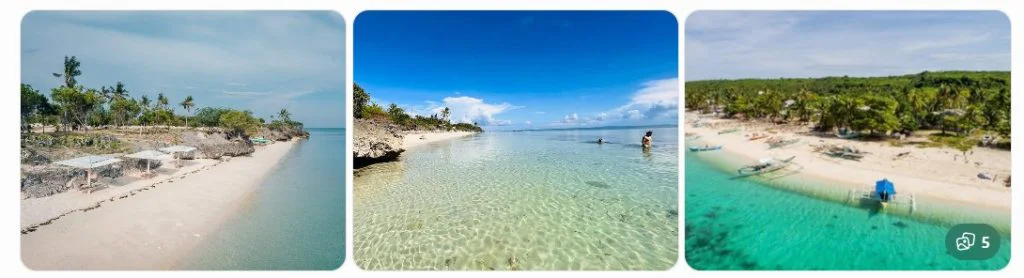
The best way to start the day
There is something special about arriving at Paradise Beach early in the morning, before the island becomes busy.
The temperature is usually pleasant, the water can be incredibly clear and the beach has a completely different atmosphere from later in the day.
I normally go there simply to swim.
No complicated plans, no organised excursion and no tourist itinerary.
Just me, the sea and a few people I have got to know over the years.
Sometimes I swim for a while and then sit on the beach talking with friends or family. Other mornings I prefer to enjoy the water quietly and then head back to Santa Fe.
After doing this for more than four years, Paradise Beach has become much more than just one of the best beaches in Bantayan Island for me.
It has become a familiar place.
Knowing the beach through the seasons
One of the advantages of living here rather than visiting for a few days is that you start noticing things that tourists normally don’t see.
The beach looks completely different depending on the tide.
At certain times the water comes right up towards the sand, while at low tide the coastline changes dramatically. The colours of the water, the exposed rocks and the surrounding landscape can all look different from one day to another.
This is also why I often tell guests at Hero House not to judge a beach from a single photograph.
Paradise Beach, also known as Sandira Beach, changes constantly.
If you visit at the right time of day and with the right tide, you can experience a completely different place.
More than a swimming spot
Over the years, Paradise Beach has also become one of the places where I regularly meet people.
Sometimes it is friends or family. Sometimes it is someone I have met previously on the island.
And sometimes there are conversations that begin with absolutely nothing.
This is another part of life in Bantayan that I enjoy. You don’t always need a reason to talk to somebody.
A greeting, a joke or a comment about the water can be enough.
After several years, I have reached the point where I sometimes joke with friends and family that if one day I die here, I would like my ashes scattered on the sand at Paradise Beach.
Maybe that sounds strange to someone reading this from thousands of kilometres away.
For me, it makes perfect sense.
I have spent so many mornings swimming here that this beach has become part of my personal history on Bantayan Island.
A local tip for visitors
If you are staying in Santa Fe and want to experience Sandira Beach / Paradise Beach, don’t simply arrive, take a photograph and leave.
Try going early.
Swim.
Walk along the coast.
Look at the water at different stages of the tide.
And, if you meet someone who greets you, say hello.
You may discover that the best part of Paradise Beach isn’t necessarily the photograph you take.
It may be the small experience you have while you are there.
This is the Paradise Beach I know after four years of almost daily swimming — not just a tourist attraction, but a small part of my everyday life in Bantayan Island.
Getting to Know Filipinos
One of the most interesting parts of living in Bantayan Island is getting to know the people who live here.
If you come to the Philippines for a holiday, you will probably notice the friendliness of Filipinos immediately. But living here is different from visiting. Over time, you begin to notice many small details about how people communicate, make friends, spend their free time and interact with their neighbours.
I have learned that you cannot understand Filipino people simply by comparing them with the culture you come from. Some behaviours that may seem strange to a foreigner make perfect sense once you understand the local way of life.
A little distance at first
Many Filipinos, especially younger people, can be quite shy when meeting foreigners.
Don’t necessarily interpret this as being unfriendly.
Sometimes they simply don’t know how to start a conversation, particularly if they are not confident speaking English. Others may deliberately keep a little distance because they don’t want to disturb you.
This is something I have noticed many times while living in Santa Fe.
But once you manage to break the ice, things can change very quickly.
A person who barely spoke to you the first time may eventually greet you every time they see you. And Filipinos have a surprisingly good memory for faces.
I often drive around town and suddenly hear someone calling me.
I turn around and think:
“Who was that?”
Sometimes I genuinely cannot remember the person.
But they remember me.
That is one of the things I find particularly nice about living here. Once you become part of someone’s circle of acquaintances, even in a very small way, you can suddenly find yourself being recognised all over town.
The Filipino habit of sitting outside
One of my favourite things to observe is the way people use the space outside their homes.
You will often see a few chairs or a simple wooden bench placed directly in front of a house, sometimes under a tree or beside the road.
People sit there for hours.
They talk, drink something, look at their phones, laugh and watch the people passing by.
At first I wondered:
“Why don’t they just sit inside the house?”
Eventually I understood.
They are not simply sitting outside.
They are watching life happen.
A neighbour passes on a motorcycle. Someone they know walks down the road. A friend stops for five minutes. Somebody waves from a passing tricycle.
It is a very simple form of social life, but it is everywhere.
And I think this is one reason why small communities in Bantayan can feel so connected.
Marites — Filipino gossip with a smile
If you spend enough time around Filipino families and neighbourhoods, sooner or later you will hear the word “Marites.”
Marites is a popular Filipino expression associated with gossip — especially someone who always seems to know the latest news.
And there is a funny side to the way information travels here.
Imagine something small happens in the neighbourhood.
One person tells another.
That person tells somebody else.
Then it reaches a friend, a relative, a neighbour…
By the time the story reaches the end of the chain, the original information may have changed considerably.
Sometimes it becomes almost unrecognisable.
Everyone wants to know the latest news and, just as importantly, everyone wants to be the person who can tell somebody else.
But be careful with the word Marites.
Calling someone a Marites can be taken as calling them a gossip, and not everybody will appreciate the joke.
Filipino pride and relationships
Another thing I have learned through experience is that Filipinos can be very proud people.
If you hurt someone’s feelings or seriously offend them, they may not simply forget about it the next day.
I have experienced this myself while building my second Hero House.
There have been disagreements and misunderstandings, and sometimes the result is surprisingly final.
You can meet the same person in the street afterwards and suddenly there is no conversation at all.
They simply ignore you.
For a foreigner, this can be difficult to understand.
My advice is simple: if you live in the Philippines, choose your words carefully and try not to humiliate someone in front of other people.
A small disagreement does not need to become a permanent conflict.
Friendship takes time
The other side of this is that once a Filipino considers you a friend, that relationship can become very strong.
The initial shyness disappears.
People remember you, ask about you, greet you in the street and sometimes go out of their way to help you.
This is one of the reasons I enjoy living in Bantayan Island.
You don’t need to become friends with everyone.
But if you spend enough time here, you gradually become part of a network of people who know you.
And suddenly Bantayan Island starts feeling less like a place where you live and more like a place where you belong.
A foreigner’s perspective
Of course, these are my personal observations after years of living in the Philippines. Not every Filipino behaves in the same way, and Bantayan Island itself is a small community with its own character.
The best way to understand Filipino culture is not to arrive with a list of stereotypes.
Come here.
Stay for a while.
Talk to people.
Watch how families interact.
Sit outside sometimes instead of always staying inside.
And most importantly, give people time to get to know you.
You may discover that the quiet person who barely spoke to you during your first week eventually becomes the person who waves at you from the other side of town.
The Filipino Habit of Sitting Outside
One of the things I noticed very quickly after living in Bantayan Island is a simple habit that says a lot about Filipino life: people love sitting outside their homes.
You will often see a few plastic chairs, a wooden bench or even a couple of improvised seats placed directly in front of a house. Sometimes they are under a tree, sometimes beside the road and sometimes in a tiny space that, to a foreigner, would seem like a rather unusual place to sit.
But there is actually a reason.
They are not just sitting there because there is nowhere else to go.
Watching the world go by
For many Filipino families, the area in front of the house is almost an extension of the living room.
People sit there talking with relatives and neighbours, drinking something, using their phones and simply watching what happens around them.
A motorcycle passes.
Someone walks down the road.
A neighbour appears.
A friend is recognised from a distance.
A quick wave can become a five-minute conversation, and that conversation can easily become half an hour.
There is no appointment.
Nobody planned it.
It just happens.
And this is something I really enjoy about life in Bantayan.
Why sit beside the road?
When I first arrived, I sometimes wondered why people would choose to sit right beside a road instead of staying inside their house.
After living here for years, I think the answer is quite simple:
They like being connected to the people around them.
Sitting outside makes it easier to see who is passing and, more importantly, to see people you know.
In a small community like Santa Fe, this creates a constant flow of small social interactions.
Someone might stop to say hello.
A neighbour might sit down for a while.
A relative might pass by on a motorcycle.
Children may come and go.
People exchange news, jokes and stories.
Nothing particularly important has to happen.
The social interaction itself is the activity.
Under the tree, beside the house
You will often find these little gathering places underneath a tree.
The shade is important, of course, especially in the tropical heat, but there is also something pleasant about sitting outside where there is a breeze and where you can watch the street.
Sometimes the furniture is extremely basic.
A few pieces of wood can become a bench.
A plastic chair can become the most comfortable seat in the world if you have good company.
And people can stay there for a surprisingly long time.
They may be drinking, chatting, laughing or scrolling through their phones while occasionally looking up to see who is passing.
Where Marites begins
These little outdoor meeting places are also part of how information travels through a Filipino neighbourhood.
Someone knows something.
Another person hears it.
Then someone else joins the conversation.
And before long, everybody seems to know the latest news.
This is where you may eventually hear about Marites, the Filipino expression commonly associated with gossip and people who always seem to know what is happening.
The funny part is that information can travel extremely quickly — but it can also change along the way.
The original story may start as something very simple.
By the time it reaches the fifth or sixth person, it can be a completely different story.
So if you are living in a small Filipino community, remember one thing:
information travels fast.
A small lesson for foreigners
I think this is one of those details that you simply don’t notice when you come to the Philippines for a one-week holiday.
You see people sitting outside, but you don’t necessarily understand what they are doing.
After years here, I see it differently.
It is not laziness.
It is not boredom.
It is not simply because people don’t have anything better to do.
It is community life happening in front of your eyes.
People want to see each other, greet each other, exchange a few words and remain connected to the neighbourhood.
And perhaps this is one of the reasons why life in Bantayan Island can feel so different from life in a large Western city.
Here, sometimes the most important part of the day is simply sitting outside and watching the people you know pass by.
Pride, Friendship & Money
Living in the Philippines for years has taught me that friendship, pride and money can sometimes be closely connected.
This is one of those subjects where a foreigner needs a little patience. What may seem like a simple financial matter can sometimes become something much more personal.
Filipino pride
Filipinos can be very proud people.
When you have a disagreement with someone, it is important to be careful about how you speak to them. Losing face or feeling publicly humiliated can damage a relationship much more than the original problem itself.
I have experienced this personally while building my second Hero House.
Over the years, I have had disagreements and arguments with people here. Sometimes the problem was eventually resolved; sometimes it wasn’t.
And when a relationship breaks down, you may discover something quite particular:
the person simply stops talking to you.
You can meet them on the street, look at each other, and walk past as if you had never known each other.
For someone coming from another culture, this can be surprising.
My advice is simple: if you live here for a long time, don’t turn every disagreement into a battle. Sometimes it is better to take a step back, give the other person time and avoid saying something that cannot be taken back.
Friendship can be very genuine
The positive side is that Filipino friendships can be extremely warm.
Once someone accepts you as a friend, they will often remember you, greet you whenever they see you and sometimes help you without expecting anything in return.
This is especially noticeable in a small community such as Santa Fe.
You may know someone only casually, but after seeing each other repeatedly over months or years, that relationship can gradually become much stronger.
I often find myself being greeted around town by people I have met at different moments in my life here.
Sometimes I still have to think:
“Wait… where did I meet him?”
But they remember me perfectly.
When money enters a friendship
Money is a different matter.
Because average incomes in the provinces can be relatively low, it is not unusual for someone you know to ask you for a loan when they have an unexpected expense.
This can put a foreigner in a difficult position.
You may genuinely want to help, but there is always the possibility that the person will not be able to repay you.
Over the years I have learned a simple rule:
If you decide to lend money, lend only an amount you can afford never to see again.
It sounds harsh, but it can save a friendship.
If you cannot afford to lose the money, think very carefully before lending it.
Sometimes the person asking for help is not trying to take advantage of you at all. They may simply have no other option. But that does not automatically mean they will have the ability to repay you later.
The other side of borrowing
There is also another problem that I have seen here.
People with limited incomes can themselves become victims of informal lenders who charge extremely high interest rates.
Someone needs money urgently, borrows it, and then discovers that paying it back becomes much harder than expected.
The cycle can continue, with one loan being used to pay another.
This is why I prefer to keep friendship and financial agreements as separate as possible.
Helping someone occasionally is one thing.
Becoming their permanent source of money is something completely different.
My rule after years here
Living in Bantayan Island has taught me that relationships are often worth more than winning an argument.
You will inevitably have disagreements with people when you live abroad. Language, culture, money and expectations can all create misunderstandings.
But if the person is someone you value, sometimes the smartest thing you can do is step back.
And when money is involved, be generous only within your limits.
Help when you genuinely want to help — but don’t lend what you cannot afford to lose.
That simple rule has saved me more than once during my years in the Philippines.
Driving in Bantayan Island: Licenses, Helmets & Checkpoints
If you are planning to explore Bantayan Island by scooter, there is something you should understand before renting one: the way driving rules are followed here can be quite different from what you may be used to in your home country.
This is based on what I have observed during my years living on the island. Rules and enforcement can change, so visitors should always check the current requirements and follow the law.
Many Filipinos learn to ride before getting a license
In the provinces, it is quite common to see people riding motorcycles from a very young age.
For many families, a motorcycle is not a luxury. It is an essential part of everyday life.
It takes children to school, adults to work, family members to appointments and people to shops. In many cases, someone learns to ride within the family and gradually becomes completely comfortable on a motorcycle long before dealing with the formal process of obtaining a driving licence.
The problem is that getting a proper licence can represent a significant expense for a low-income family.
From what I have seen, the costs can include a medical examination, driving school, transportation to the appropriate LTO (Land Transportation Office) and, in some cases, making the journey more than once if the examination or practical requirements are not completed successfully.
When you add everything together, the total cost can become several thousand pesos.
For somebody earning only a few hundred pesos a day, this is a serious amount of money.
That helps explain why you can sometimes see people riding motorcycles without having completed the formal licensing process.
It does not make it legal — it explains part of the economic reality behind what you see on the island.
Helmets: things have changed
Motorcycle helmet enforcement has also become more noticeable.
For a long time, Santa Fe had a reputation for being relatively relaxed about helmet use, particularly for passengers.
That has changed.
Requirements and enforcement can change over time, and visitors should assume that proper helmets are required and use them every time they ride.
Don’t copy what you see a local doing.
If you are a foreign visitor, the safest approach is simple:
wear a proper helmet, carry the required documents and follow the current regulations.
Local checks and police checkpoints
You may also encounter different types of roadside checks.
There can be small local enforcement groups consisting of only a few people, sometimes stationed in one place and checking basic things such as helmet use.
Then there are more formal police checkpoints, which are generally much more obvious, with vehicles, signs and officers checking traffic.
On a small island, you quickly learn where these checks tend to appear.
I’ve often seen riders slow down or stop some distance before a checkpoint.
Again, this is an observation of what happens in everyday life — it is not something I recommend doing.
If you are riding legally, the simplest solution is to approach the checkpoint normally and show the required documents if asked.
Foreign visitors and international driving permits
For foreigners, the situation is different.
Visitors arriving in the Philippines may be able to drive using a valid foreign licence and/or an International Driving Permit, subject to the applicable Philippine rules and time limits.
The practical enforcement can also vary between locations.
If you intend to stay longer or live in the Philippines, don’t assume that the documents that worked during your first weeks will automatically remain sufficient forever.
Check the current requirements with the appropriate Philippine authorities before relying on your foreign licence.
Motorcycles are receiving more attention
Motorcycles are increasingly being checked for more than simply having a rider wearing a helmet.
Depending on the location and enforcement operation, authorities can check registration, documents and whether the motorcycle has been modified.
This is particularly relevant to motorcycles with non-standard or excessively loud exhaust systems.
On Bantayan Island, as elsewhere in the Philippines, I have seen increasing attention given to modified motorcycles and noisy exhausts.
There have even been highly publicised enforcement actions in the Philippines involving confiscated modified exhaust systems.
So if you rent a scooter, my advice is very simple:
rent a properly registered motorcycle in standard condition and don’t modify it.
My advice to visitors
If you are staying at Hero House and plan to explore Bantayan Island by scooter, remember that the motorcycle gives you enormous freedom.
You can reach Paradise Beach, Kota Beach, Sugar Beach, Bantayan Town, Madridejos and many smaller places at your own pace.
But that freedom comes with responsibility.
Before riding:
- Make sure you have the correct licence and documents.
- Wear a proper helmet.
- Check that the motorcycle is properly registered.
- Avoid modified or excessively loud exhaust systems.
- Follow current local traffic regulations.
- Slow down and ride defensively.
- Never assume that because locals do something, it is legal for you to do the same.
The best way to enjoy driving around Bantayan Island is not to worry about checkpoints.
Have the right documents, wear your helmet and simply ride legally.
That way you can concentrate on what you came here for: discovering the island.
Sundays, Beaches & Filipino Families
If you want to understand a little more about everyday life in the Philippines, watch what happens on a Sunday in Bantayan Island.
Sunday is different.
For many Filipino families, it is the day to spend time together, and one of the favourite destinations is, of course, the beach.
After Mass, the beach becomes the destination
In many families, Sunday morning starts with church.
After Mass, especially from around late morning, families begin moving towards the coast.
And when I say families, I mean the whole family.
Parents, children, grandparents, relatives and friends can all end up going together.
The beach is not simply a place to swim for an hour.
It can become the destination for the entire day.
Families arrive carrying food, cooking equipment, water and everything they need to stay for several hours.
You may see people carrying pots, large containers of water, bags of food and all kinds of things that make you wonder how they managed to bring the entire kitchen with them.
Then they find a place under the trees or beside the beach and settle in.
The beach becomes a family picnic
For many visitors, going to Bantayan Island beaches means swimming, taking photographs and relaxing.
For Filipino families, the experience can be much more social.
They eat together.
They talk.
The children play.
Someone puts on music.
People swim for a while and then return to their family group.
Lunch can become a long afternoon meal, followed by more talking and eventually another swim.
The beach becomes an extension of the family home for the day.
This is one of the things I enjoy watching when I go to Paradise Beach.
After years of swimming there almost every morning, I have seen this Sunday routine many times.
During the week the beach can feel relatively quiet.
On Sunday, the atmosphere can change completely.
Why do many Filipinos prefer shade?
There is another funny difference that visitors may notice.
Many Filipinos actually try to avoid getting too much sun.
For a European tourist, lying under the tropical sun and getting a tan may be one of the main reasons for coming to the Philippines.
For many Filipinos, the opposite is true.
A darker complexion is often something they would rather avoid, and you may see people using umbrellas, hats, towels, long sleeves or other ways of protecting themselves from the sun.
Skin-whitening products are also widely marketed in the Philippines.
So while the foreign tourist is looking for the strongest possible sunshine to get a beautiful tropical tan, the Filipino family may be sitting comfortably under a tree trying to stay in the shade.
I find the contrast amusing.
And then there are the swimming pools
Another thing that surprised me when I started living here was how much some Filipinos enjoy swimming pools.
Bantayan Island has beautiful, crystal-clear seawater.
You can have a spectacular tropical beach right in front of you.
And yet, given the choice, some families will happily spend the afternoon in a resort swimming pool.
As a foreigner, you might think:
“But why are you in the pool when the sea is right there?”
There isn’t necessarily an answer.
The pool is simply part of the experience.
For families, it can be easier, more comfortable and more familiar, especially when there are children.
Sunday is about being together
The important thing is not really whether they choose the sea or the pool.
It is being together.
The beach provides a place where several generations can spend the day together without needing an expensive activity or complicated plans.
Bring some food.
Bring water.
Find some shade.
Talk.
Laugh.
Swim.
Listen to music.
Stay until the afternoon.
That is enough.
And if you are visiting Bantayan Island on a Sunday, don’t be surprised if the beaches feel very different from what you experienced during the week.
You are not simply seeing a tourist beach.
You are seeing Filipino family life moving outdoors.
For me, this is one of the most beautiful things about living on Bantayan Island: the sea is not only a destination for tourists.
For local families, it is part of everyday life.
Music, Karaoke & TikTok
If there is one thing you quickly discover after living in the Philippines, it is that Filipinos really love music.
And I’m not talking only about listening to music.
They love singing it, sharing it, dancing to it and turning almost any occasion into an excuse for a little entertainment.
This is particularly noticeable in Bantayan Island, where music can suddenly appear almost anywhere.
The Filipino love of music
Walk around Santa Fe or the smaller villages and you will often hear music coming from someone’s house, a small shop or a gathering of friends.
It doesn’t necessarily have to be a special occasion.
Someone has a speaker.
Someone has a phone.
And suddenly there is music.
Filipinos are generally very comfortable having music around them while they are eating, drinking, working, relaxing or spending time with friends.
For a foreigner, it can sometimes be surprising how quickly a quiet afternoon can turn into a small party.
Karaoke is almost a national sport
And then there is karaoke.
If you haven’t experienced Filipino karaoke yet, you haven’t completely experienced the Philippines.
A karaoke machine or speaker is enough.
The microphone appears.
Someone chooses a song.
And then everybody waits to see who is brave enough to start singing.
The funny thing is that you absolutely do not need to be a good singer.
In fact, sometimes the worse the singing, the more entertaining the evening becomes.
Nobody seems particularly worried about hitting every note perfectly.
The important thing is to participate, have fun and enjoy the moment.
I’ve seen karaoke appear in situations where, from a European perspective, you would never expect it.
Give people a microphone and a speaker and there is a good chance somebody will start singing.
Singing together
Karaoke is also very social.
One person starts.
Another joins.
Then somebody else chooses a song.
Before long, several people are sitting together, laughing, drinking and singing.
It isn’t really about performing for an audience.
It is about being together.
This is something that makes Filipino karaoke different from the image many foreigners have of karaoke as a formal activity in a dedicated karaoke bar.
Here, it can be much more spontaneous.
A family gathering, a birthday, a weekend afternoon or simply friends sitting outside can be enough.
The younger generation and TikTok
The younger generation has taken this love of music in another direction.
TikTok has become a huge part of everyday entertainment, especially among younger Filipinos.
You will see people filming short dance videos, copying popular routines, lip-syncing to songs and creating their own versions of whatever trend is currently circulating.
And they don’t necessarily need a studio or special equipment.
A phone is enough.
Find a suitable place, start the music and record.
Sometimes several friends participate together, and sometimes someone is perfectly happy dancing alone in front of the camera.
For a foreigner, it can be amusing to watch how seriously some of them concentrate on getting the choreography right.
Dancing is entertainment
The younger generation especially seems to enjoy dancing and creating short videos.
You may see groups of friends practising a TikTok routine, repeating the same sequence several times until they are happy with the result.
It is another example of how social media has become integrated into everyday life.
What used to require a television programme, a stage or a music video can now be created by anyone with a smartphone.
And once it is recorded, it immediately becomes something to share with friends.
Music brings people together
For me, this is another small detail that makes life in Bantayan Island interesting.
Music isn’t always something you deliberately go somewhere to experience.
Sometimes it simply appears around you.
You hear a song coming from a house.
You see a family singing karaoke.
A group of young people is filming a TikTok dance.
Someone is sitting outside with a speaker playing music.
And somewhere nearby, somebody is probably preparing to sing the next karaoke song.
It can be noisy.
It can occasionally be very noisy.
But it is also part of the character of Filipino life.
Here, music isn’t just entertainment. It is often a way of spending time together.
Cockfighting, Gambling & Sabong
If there is one subject that gives a foreigner a very different perspective on Filipino culture, it is Sabong — cockfighting.
For many Filipinos, especially in the provinces, Sabong is not simply a sport. It is part of a much wider culture of competition, breeding, pride and gambling.
You will see people who know the bloodlines of their roosters, discuss which bird is stronger and spend considerable time preparing them for a fight.
And, of course, there is money involved.
The importance of gambling
Filipinos love games of chance.
Even when money is limited, it is not unusual to see people buying lottery tickets or placing small bets.
For some people, the dream is simple: a small amount of money could suddenly become a much larger amount.
Sabong takes this idea much further.
Inside a cockfighting arena, two roosters face each other while spectators place bets on the outcome.
There is a very simple logic to it:
your rooster wins, you win the bet.
Your rooster loses, your money is gone.
And, of course, there is always another fight.
The Sabong arena
In the provinces you can sometimes find dedicated cockfighting arenas, often surprisingly large structures with corrugated metal roofs.
Inside, the atmosphere can become extremely intense.
People watch the roosters carefully.
They discuss the animals.
They shout.
They place bets.
And once the fight begins, everyone’s attention is concentrated on those few moments.
For someone seeing Sabong for the first time, it can be quite shocking.
The atmosphere is not necessarily what you would expect from a conventional sporting event.
There is much more money and emotion involved.
The mathematics of gambling
The attraction is easy to understand.
Imagine two people betting on two different roosters.
There is theoretically a roughly 50/50 chance of choosing the winner, before considering the organiser’s share and the particular betting system.
If you win, you have more money.
So what do many people do?
They bet again.
And if they win again, they may bet again.
This is where gambling becomes dangerous.
The money won is often not treated as profit.
It becomes the money for the next bet.
Eventually, the sequence usually ends the same way gambling sequences tend to end: somebody loses.
Where does the money really come from?
There is another side to Sabong that fascinates me.
If you want to participate seriously, you need a rooster.
And that means breeding and raising fighting cocks.
People invest time and money in their animals, selecting particular birds and trying to produce stronger offspring.
A successful breeder can therefore have something much more valuable than a single rooster.
They have a breeding line.
For some enthusiasts, this is almost a science.
They know which birds produced which offspring, which animals performed well and which characteristics they want to reproduce.
And what happens to the loser?
This is perhaps the most obvious difference for someone who comes from Europe.
The losing rooster does not simply walk away from the arena.
The animal may be killed during the fight.
The winner’s owner can receive the defeated rooster, depending on the rules and arrangement of the fight.
And this leads to another part of the culture:
the rooster can eventually become food.
You will hear people say that fighting-cock meat is good.
Personally, I have never been particularly interested in eating it.
Perhaps because I know exactly where the animal came from.
More than gambling
For people deeply involved in Sabong, it isn’t necessarily only about the money.
There is pride involved.
A good rooster reflects well on its owner.
Breeding a successful animal can give someone considerable status within their community.
People remember which rooster won.
They remember the breeder.
And they remember the fights.
This is why Sabong can be difficult for a foreigner to understand if you look at it only as gambling.
It is also connected to tradition, social relationships, breeding and local identity.
My personal view
I have never been particularly attracted to cockfighting, and I don’t gamble on it.
But after years living in Bantayan Island, I have learned that you cannot understand Filipino provincial life by looking only at the things that are familiar to you.
Sabong is one of those things.
You may agree with it or strongly disagree with it, but it is part of the cultural landscape you encounter in parts of the Philippines.
And if you spend enough time here, sooner or later somebody will probably ask you the inevitable question:
“Which rooster do you think will win?”
That’s when you realise you’ve been in the Philippines long enough to have entered the conversation.
Shopping in the Philippines: Why Everything Comes Online
One of the things that surprised me after living in the Philippines for several years is how much shopping has moved online.
Coming from Italy, I was used to having specialised shops everywhere: a hardware store with hundreds of small parts, an electrical shop, a shop for tools, another for household items, and somewhere nearby you could usually find that strange little screw, adapter or battery you suddenly needed.
In the provinces of the Philippines, things can be very different.
Hardware stores are everywhere — but not for everything
In Bantayan, you will find plenty of hardware stores.
But most of them are primarily focused on construction materials.
You can buy cement, steel bars, plywood, Hardiflex, paint, pipes and all the things needed to build or renovate a house.
What can be surprisingly difficult to find are the small specialised items.
A particular screw.
A battery for an unusual device.
A specific adapter.
A replacement part.
A particular tool.
Something that in another country you would simply buy from a specialised shop.
Here, the answer is often:
“Out of stock.”
And sometimes you discover that several shops in town don’t carry the item at all.
Then you discover Lazada
This is where online shopping becomes extremely useful.
Platforms such as Lazada and other online marketplaces have become an essential part of everyday life in the Philippines.
Suddenly, the small item you couldn’t find anywhere locally can be ordered from your phone.
Clothing, electronics, tools, household equipment, spare parts, appliances and an enormous variety of other products can be delivered directly to your door.
For someone living on an island, this is particularly important.
You don’t have to travel to Cebu City simply because you need a particular product.
You search online, place the order and wait for the rider.
The riders are everywhere
One of the things you quickly notice is just how many delivery riders are operating in the Philippines.
Motorcycles are everywhere, and so are delivery packages.
Go to a local collection or distribution point and you can sometimes see mountains of parcels waiting to be delivered.
The system works because the country has developed an enormous network of small motorcycle-based deliveries.
For ordinary-sized packages, delivery can be surprisingly inexpensive.
A shipment costing around ₱100 can often move a medium-sized parcel, although prices vary depending on the seller, distance, promotions and the delivery service.
And there is another option that remains extremely popular:
Cash on Delivery (COD).
Cash on Delivery
Many Filipinos prefer to pay when the package arrives.
You order the product online, the rider arrives at your house, you pay the amount due and receive the package.
There may be a small additional charge depending on the service or seller, but for many people the convenience is worth it.
It also makes online shopping accessible to people who don’t regularly use credit cards or online payment systems.
For somebody living in the Philippines, this combination of cheap delivery and COD makes online shopping incredibly convenient.
Building a house through online shopping
I have personally experienced just how far this can go.
While building my own house, I ended up buying thousands of dollars worth of products online.
I ordered everything from small items to surprisingly large purchases, including air-conditioning units.
When you live on an island, this can save an enormous amount of time.
Instead of spending days looking through local shops for something specific, I can search online and compare products immediately.
Sometimes the internet is simply the only realistic way to find what I need.
But large deliveries are another story
There is one important limitation.
The Philippine delivery system is incredibly efficient for small and medium-sized packages, but it is not always designed for very large objects.
Many delivery riders use motorcycles.
That works perfectly for boxes, clothes, electronics and household items.
It becomes considerably more complicated when the object is too large to safely carry on a motorcycle.
There are larger transport options, but the system is not as straightforward as simply having a large delivery van arrive at your house.
For an island such as Bantayan, logistics can become even more complicated.
Why many businesses don’t keep large stocks
Another interesting thing you notice in provincial businesses is that many shops don’t want to invest too much money in inventory.
Instead of buying a large quantity of products and keeping them on the shelves, they may ask for a deposit or advance payment and then order the product specifically for you.
You might hear something like:
“Give me a deposit and I can get it for you in about ten days.”
At first this can seem strange to a foreigner.
But economically, it makes sense.
A small provincial business cannot afford to keep thousands of pesos tied up in products that might sit on a shelf for months without being sold.
So the customer places the order, pays a deposit and the shop obtains the product from the supplier.
Everything comes from Cebu
For Bantayan Island, Cebu City is the major supply connection for many products.
Trucks and other forms of transport constantly move goods between Cebu and the island.
Construction materials, household products, commercial supplies and many other goods eventually make their way onto Bantayan through this supply chain.
This is another reason why a shop may tell you that something will arrive in several days.
It may not be sitting in a warehouse nearby.
It has to be ordered, transported to the island and then delivered locally.
Food is different
Food is where the system becomes more complicated.
Products that don’t require refrigeration can sometimes be transported relatively easily.
But fresh or temperature-sensitive products are another story.
Except for certain commercially handled products such as ice cream, many foods that require reliable refrigeration cannot simply be ordered online and delivered to a remote island in the same way as a pair of shoes or an electronic device.
Sometimes the practical solution is to have the product delivered to a second address in Cebu, and then arrange the transport to Bantayan yourself.
This is something you quickly learn when you live here.
Online shopping has changed island life
For me, this is one of the most interesting examples of how technology has changed everyday life in the Philippines.
You can live on a relatively small island and still have access to an enormous catalogue of products.
You don’t necessarily need a specialised shop around the corner.
You need:
a smartphone, an internet connection and a delivery rider.
And suddenly that little replacement part you couldn’t find anywhere in Santa Fe can be sitting on your doorstep a few days later.
For someone living on Bantayan Island, online shopping isn’t simply convenient.
It has become part of how island life works.
Things I Wish I Had Known Before Living in Bantayan
Living in Bantayan Island for years has taught me that living here is very different from simply visiting.
As a visitor, you see the beaches, the turquoise water, the sunsets, the scooters and the relaxed island lifestyle. When you actually live here, you start noticing hundreds of small details that tourists normally never encounter.
None of these things are necessarily good or bad. They are simply part of everyday life in the Philippines, and understanding them makes living here much easier.
Everything Takes a Little More Time
One of the first things I learned is not to expect everything to happen immediately.
A repair that would take one day somewhere else might take several days here. A part may need to come from Cebu City. A delivery may arrive tomorrow, or perhaps the day after tomorrow. A business may tell you that something is available, only for you to discover that it is actually out of stock.
The solution is simple: learn to plan ahead and don’t get angry about things you cannot control.
Island life has its own rhythm.
If You Need Something, Don’t Assume You Can Buy It
Bantayan has plenty of hardware stores, supermarkets, shops and small businesses, but you may be surprised by what is difficult to find.
You can easily find cement, plywood, steel bars, paint and construction materials. Finding a particular screw, battery, electrical component, tool, spare part or specialized household item can be much harder.
This is one reason online shopping has become so important in the Philippines.
Platforms such as Lazada and Shopee have completely changed everyday life, especially in the provinces. I have personally bought an enormous amount of things online while building my properties — from small household items to surprisingly large equipment.
The island may feel remote, but your shopping list doesn’t have to be.
Cebu City Is Still Part of Your Life
Living on an island does not mean you can completely forget about Cebu City.
For certain products, documents, specialist services, repairs or larger purchases, Cebu remains the place where things happen.
Goods continuously travel between Cebu and Bantayan. Trucks arrive with supplies, businesses collect orders and residents organize their own transportation when something too large or complicated cannot simply be delivered to their door.
Eventually you learn which things you should buy locally, which things you should order online and which things are worth waiting for on your next trip to Cebu.
Cash Is Still Important
Even though digital payments are becoming increasingly common, cash remains extremely useful in Bantayan.
Small shops may not have enough change for a ₱1,000 note, particularly if they have not had many customers that day.
I normally change large notes whenever I have the opportunity, especially at larger supermarkets or established businesses.
It is a small habit, but it can save you from standing in a little shop holding a ₱1,000 bill while the owner looks at you as if you have just handed them a treasure chest.
Learn to Read the Situation, Not Just the Words
Communication in the Philippines is not always about vocabulary.
Sometimes a person will say “yes” because they don’t want to disappoint you, even when the real answer is “I’m not sure.”
Sometimes “tomorrow” really means tomorrow.
And sometimes it means “when it becomes possible.”
This is not necessarily dishonesty. Cultural communication can be different, and avoiding direct confrontation is often important.
With time, you learn to ask questions differently, confirm important information and, above all, not become frustrated too quickly.
Relationships Matter
One of the most beautiful things about living in a small Filipino community is that people remember you.
Once you become familiar to people, you may discover that you know someone everywhere you go.
You can drive through town and suddenly hear someone shouting your name. You turn around thinking:
“Who is that?”
And then you spend the rest of the day trying to remember where you met them.
But they remember you.
This is one of the things I genuinely like about life here. Communities can still feel personal.
Respect Goes a Long Way
Filipinos generally appreciate politeness and respect, and relationships can be very important.
At the same time, I have learned that arguments and confrontations can have longer consequences than you might expect.
When someone’s pride is hurt, simply saying “sorry” later does not always make everything disappear.
My advice is simple: be respectful, be patient and choose your battles carefully.
Living here means dealing with the same people repeatedly — your neighbors, workers, shop owners, drivers and local businesses. Keeping a good relationship is often worth much more than winning an argument.
Island Life Is Wonderful — But It Is Still Real Life
Perhaps the biggest thing I wish I had understood before living here is that Bantayan Island is not a permanent holiday.
There are beautiful beaches, spectacular sunsets, warm people and an incredible sense of freedom.
But there are also construction delays, bureaucracy, traffic checks, missing products, power interruptions, difficult deliveries, paperwork and all the ordinary frustrations that exist anywhere people live.
The difference is that here, those frustrations happen while you are surrounded by palm trees and turquoise water.
And honestly, that helps.
My Advice After Years Here
If you are thinking about staying in Bantayan Island for a long time, don’t try to change the island into the place you came from.
Learn how it works.
Learn the people. Learn the roads. Learn where to buy things. Learn when to use cash. Learn when to order online. Learn when to wait.
And most importantly, learn to appreciate the things that cannot be bought or organized: the people who recognize you in the street, the spontaneous conversations, the family gatherings outside houses, the sound of karaoke from somewhere nearby and the feeling that, after enough time, the island starts to feel like home.
That is probably the biggest lesson Bantayan has taught me.
A Final Note from Manilo
After living in Bantayan Island for years, I have learned that the best way to understand this place is not by looking at it as a tourist.
You have to live here.
You have to ride the same roads every day, stop at the same little shops, know the people in your neighborhood, experience the good days and the frustrating ones, and slowly understand why things are done differently here.
I came from Italy, but Bantayan has taught me that adapting to a place does not mean losing who you are. It means learning to appreciate another way of living.
Every morning, I still find myself looking at the sea and thinking how lucky I am to be here.
For four years, I have gone almost every morning to Paradise Beach, simply to swim. It has become part of my daily life rather than a tourist attraction. I have even joked with friends and family that, if one day I should die here, I would like my ashes to be scattered on that sand.
Maybe that says everything.
I didn’t come to Bantayan simply to build a business or another house.
I came here, and somewhere along the way, Bantayan became home.
— Manilo
Founder of Hero House • Santa Fe, Bantayan Island
A Name That Somehow Knew My Future
There is one thing I have always found amusing about my life in the Philippines.
My name is Manilo.
So where could a man named Manilo possibly end up living?
Manila, of course.
Well… I didn’t quite make it to Manila. I made it to the Philippines anyway, and eventually to Bantayan Island.
Sometimes I joke that my father was incredibly far-sighted. He gave me a name that sounded perfectly at home in the Philippines 54 years before I actually arrived here.
Maybe he knew something I didn’t.
Or maybe it is just one of those strange coincidences that make life a little more interesting.
Either way, after all these years living in Bantayan, I have to admit that Manilo in the Philippines doesn’t sound strange at all.
— Manilo